

Introduction
Choosing the best AC for home can be difficult when there are so many brands, capacities, technologies and features available in the market. From 1 Ton and 1.5 Ton models to 5 Star inverter ACs, every model is designed for different requirements.
The right air conditioner depends on more than just the price. Room size, cooling requirement, usage hours, energy efficiency, installation conditions and useful features should all be considered before making a purchase.
Whether you are buying an AC for a bedroom, living room, office or another space, this guide will help you understand the important factors to consider before choosing an air conditioner in 2026.
What Should You Consider Before Buying an AC?
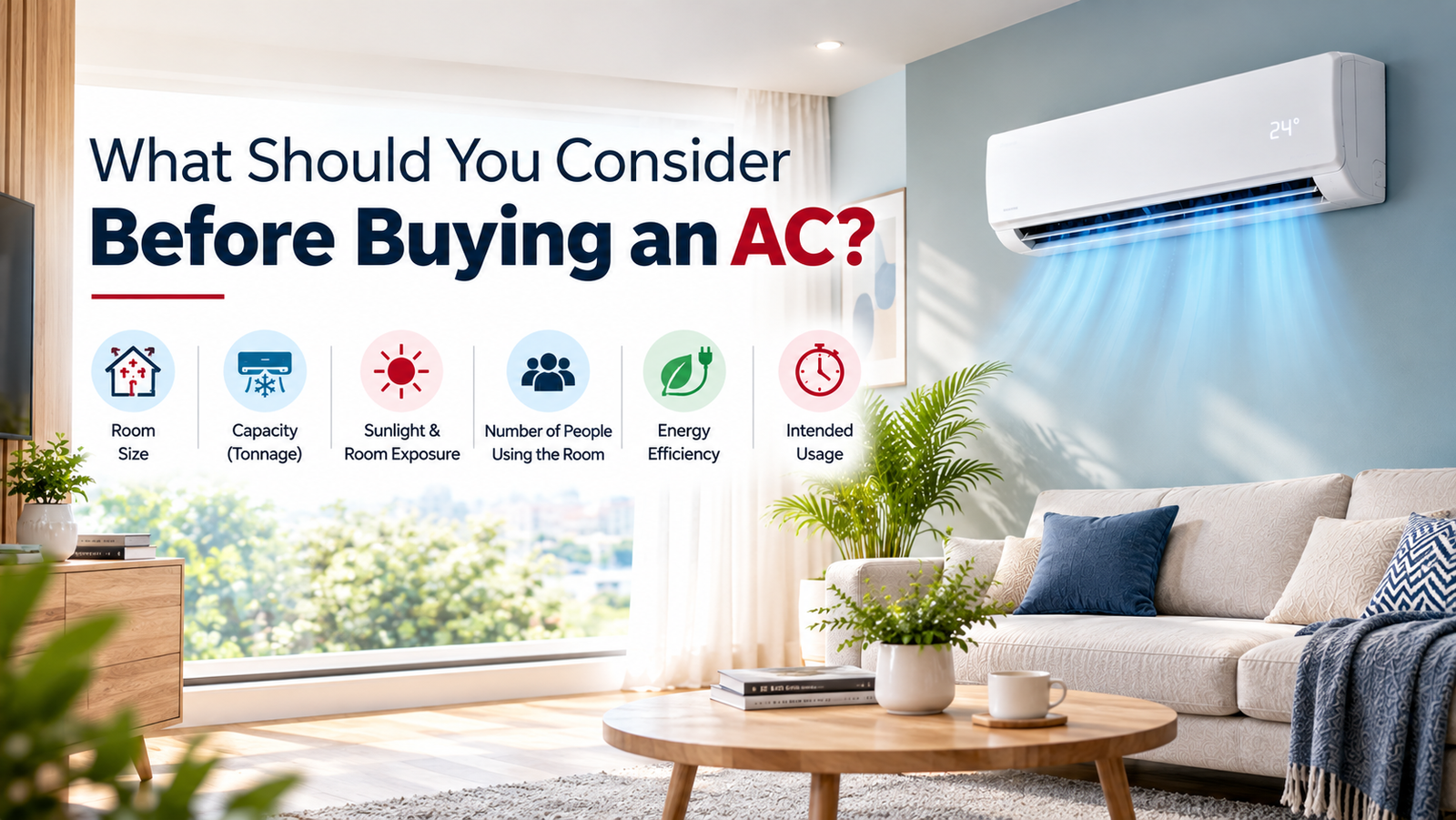
Before purchasing an air conditioner, start by understanding the room where it will be installed.
Some of the most important factors to consider are:
- Room size
- Required cooling capacity
- Inverter or fixed-speed technology
- BEE star rating
- Energy consumption
- Sunlight exposure
- Number of people using the room
- AC features
- Installation requirements
- Warranty and after-sales service
Instead of choosing an AC only because it has a particular brand name or discount, compare the specifications and select a model that matches your actual requirements.
Choose the Right AC Capacity
AC capacity is commonly discussed in terms of tonnage, such as 1 Ton, 1.5 Ton and 2 Ton.
The required capacity depends on several factors, including room size, ceiling height, sunlight exposure, insulation and the number of people regularly using the room.
1 Ton AC
A 1 Ton AC may be suitable for smaller rooms where the cooling requirement is relatively low.
It can be considered for spaces such as:
- Small bedrooms
- Study rooms
- Compact offices
- Smaller living spaces
However, room conditions should always be considered before selecting the final capacity.
1.5 Ton AC
A 1.5 Ton AC is a commonly considered option for medium-sized rooms.
It may be suitable for:
- Bedrooms
- Medium-sized living rooms
- Small offices
- Rooms with moderate cooling requirements
If you use the AC for several hours every day, compare different 1.5 Ton models based on energy efficiency, features and overall specifications.
2 Ton AC
A 2 Ton AC may be considered for larger rooms or spaces with a higher cooling load.
Before selecting a 2 Ton model, consider the actual room conditions rather than simply choosing a larger capacity.
Tip: There is no universal room-size rule that works for every home. Sunlight, insulation, ceiling height and occupancy can change the cooling requirement.
Inverter AC vs Fixed-Speed AC
One of the most important decisions when buying an AC is choosing between inverter and fixed-speed technology.
What Is an Inverter AC?
An inverter AC can vary compressor operation according to the cooling requirement. Instead of operating in the same way throughout, the compressor can adjust its operation as the cooling demand changes.
This can help provide more consistent temperature control and can be useful for people who operate their AC for longer periods.
An inverter AC may be worth considering if you:
Are looking at energy-efficient models
Use the AC regularly
Run the AC for several hours
Want variable compressor operation
What Is a Fixed-Speed AC?
A fixed-speed AC generally operates the compressor in an on/off cycle to maintain the selected temperature.
It may be considered by users who:
- Use the AC occasionally
- Have a lower initial budget
- Do not require inverter technology
The right choice depends on your usage pattern, budget and electricity-consumption priorities.
What Does the BEE Star Rating Mean?
Energy efficiency is an important factor when buying an AC in India.
The Bureau of Energy Efficiency (BEE) uses a star-rating system to communicate the energy performance of appliances. A higher star rating indicates higher rated energy efficiency within the applicable product category. Room air conditioners are covered under the BEE Standards & Labelling programme.
For air conditioners, energy performance is associated with ISEER (Indian Seasonal Energy Efficiency Ratio). BEE documentation identifies ISEER as an important parameter for room air conditioners.
Is a 5 Star AC Better?
A 5 Star AC has a higher rated efficiency than lower-star models within the relevant category.
However, the actual benefit you get depends on factors such as:
- How many hours you use the AC
- How frequently you use it
- Electricity tariff
- Room conditions
- AC capacity
- Model-specific energy performance
Therefore, don’t compare the star rating alone. Check the BEE label and the manufacturer’s specifications before making your decision.
Check Energy Consumption Before Buying
Energy consumption can make a significant difference when an AC is used regularly.
Two AC models with similar cooling capacity may have different energy-performance specifications. Before purchasing, compare the information available on the energy label and product specification.
This is particularly useful if you plan to use the AC for several hours every day.
BEE’s Standards & Labelling programme is designed to give consumers information that helps them compare the energy performance of appliances and consider potential running-cost differences.
Important AC Features to Look For
Modern air conditioners can include many features. However, you don’t necessarily need every feature available.
Choose features based on how you actually use your AC.
Inverter Technology
Inverter technology allows the compressor to adjust its operation according to cooling demand. It can be particularly useful for users who operate their AC regularly.
Fast Cooling Mode
Some ACs include a fast or turbo cooling mode designed to provide stronger cooling for a limited period.
This can be useful when you want to cool a warm room quickly.
Sleep Mode
Sleep mode is designed for nighttime use and can adjust the cooling operation according to the manufacturer’s programming.
It can be useful for bedrooms where the AC runs for several hours during the night.
Air Filters
Different AC models can come with different filter technologies.
If indoor air quality is important to you, check the manufacturer’s specifications to understand what type of filter is included and what it is designed to do.
Wi-Fi and Smart Controls
Some modern ACs offer Wi-Fi connectivity and smartphone controls.
These features may allow you to control the AC remotely, check settings or integrate it with compatible smart-home systems.
Smart features are useful, but they should not be the only reason to choose a particular AC.
Split AC vs Window AC
Another important decision is whether to buy a split AC or window AC.
A split AC consists of separate indoor and outdoor units.
Some common reasons buyers consider split ACs include:
- Modern appearance
- Quiet indoor operation in many models
- Wide range of available models
- Availability of inverter technology
- Flexible installation possibilities
Split ACs are commonly considered for bedrooms, living rooms and offices.
A window AC combines the major components into a single unit designed for window installation.
It may be suitable when:
- A suitable window opening is available
- The room is relatively compact
- Installation simplicity is important
- The buyer prefers a single-unit design
The choice depends on the room layout, installation requirements, budget and personal preference.
Which AC Is Suitable for a Bedroom?
When buying an AC for a bedroom, focus on cooling capacity, energy efficiency, noise level and useful comfort features.
A 1 Ton or 1.5 Ton model may be considered depending on the room size and cooling requirement.
If the AC will be used every night during summer, compare models carefully for:
- Energy efficiency
- Inverter technology
- Noise specifications
- Sleep mode
- Cooling performance
- Warranty
A quieter AC can also be an important consideration for people who are sensitive to operating noise while sleeping.
Which AC Is Suitable for a Living Room?
Living rooms can have different cooling requirements depending on their size, number of occupants, sunlight exposure and layout.
Before buying an AC for a living room, consider:
- Room dimensions
- Number of people
- Sunlight entering the room
- Ceiling height
- Windows
- Insulation
- Usage hours
- Heat generated by other appliances
A larger room does not automatically mean you should buy the largest AC available. The capacity should match the actual cooling requirement.
Why Proper AC Installation Matters
Choosing the right AC is only one part of the process. Proper installation is also important.
The indoor and outdoor units should be installed according to the manufacturer’s requirements.
Before installation, consider:
- Indoor unit placement
- Outdoor unit location
- Drainage
- Electrical requirements
- Airflow
- Service accessibility
- Space around the outdoor unit
A professional installation can help ensure that the system is installed according to the manufacturer’s specifications.
AC Maintenance Tips
Regular maintenance can help keep your air conditioner operating properly.
Here are some simple maintenance practices:
- Clean or replace filters as recommended
- Keep the outdoor unit free from unnecessary obstruction
- Check the drainage system
- Keep the indoor unit clean
- Get professional servicing when required
- Follow the manufacturer’s maintenance instructions
Clean filters and proper airflow are important for efficient operation. BEE’s energy-efficiency guidance also highlights regular filter cleaning as an energy-saving practice.
How to Choose the Best AC for Home
Before buying an AC, use this simple checklist:
Room Size → Cooling Capacity → Inverter/Fix-Speed → Star Rating → Energy Consumption → Features → Installation → Warranty
For example, if you have a medium-sized bedroom and use the AC for several hours every day, you can compare suitable 1.5 Ton inverter models based on energy efficiency, features and price.
If you have a larger living room, compare higher-capacity models based on the actual cooling requirement of the space.
The goal is not simply to find the most expensive AC. The goal is to find a model whose capacity, technology and features match your requirements.
Why Buy Your AC from RK Vision?

At RK Vision, you can explore different air conditioner options and compare models based on capacity, brand, features and energy efficiency.
Before purchasing, check the product specifications carefully and choose an AC that matches your room and usage requirements.
Whether you are looking for an AC for a bedroom, living room or office, comparing multiple models can help you make a more informed purchase decision.
Explore the AC collection at RK Vision and find an AC that fits your requirements.
Frequently Asked Questions About ACs
Which AC is best for home?
The best AC for home depends on your room size, cooling requirement, usage hours, energy-efficiency preference and budget. There is no single AC model that is suitable for every home.
Is a 1.5 Ton AC good for a bedroom?
A 1.5 Ton AC can be suitable for many medium-sized bedrooms, but the correct capacity depends on room size and other cooling-load factors.
Is a 5 Star AC worth buying?
A higher BEE star rating indicates higher rated energy efficiency within the applicable product category. Whether it is worth the additional purchase cost depends on your usage, electricity tariff and the price difference between models.
Which is better: inverter or fixed-speed AC?
Both technologies can suit different users. Inverter ACs can vary compressor operation according to cooling demand, while fixed-speed ACs generally operate through an on/off compressor cycle.
What should I check before buying an AC?
Check the cooling capacity, BEE star rating, energy consumption, inverter technology, features, installation requirements, warranty and after-sales support.
How can I reduce AC electricity consumption?
Use the AC according to the manufacturer’s recommended settings, keep filters clean, maintain proper airflow and ensure the system is serviced when required. Room insulation and avoiding unnecessary heat gain can also help.
Conclusion
Choosing the best AC for home is about finding the right balance between cooling capacity, energy efficiency, technology, features and budget.
Start by understanding your room size and cooling requirement. Then compare suitable AC capacities, inverter or fixed-speed technology, BEE star ratings, energy consumption and useful features.
Don’t choose an AC only because it has a higher price or more features. Instead, focus on what you actually need and compare the specifications carefully.
With the right information, you can choose an AC that is better suited to your home, usage pattern and cooling requirements.
Explore AC options at RK Vision and compare the available models before making your purchase.